
O Level vs Matric in Pakistan: Subjects, Fees & Future Options
6 min readBy Roots Home Tutors
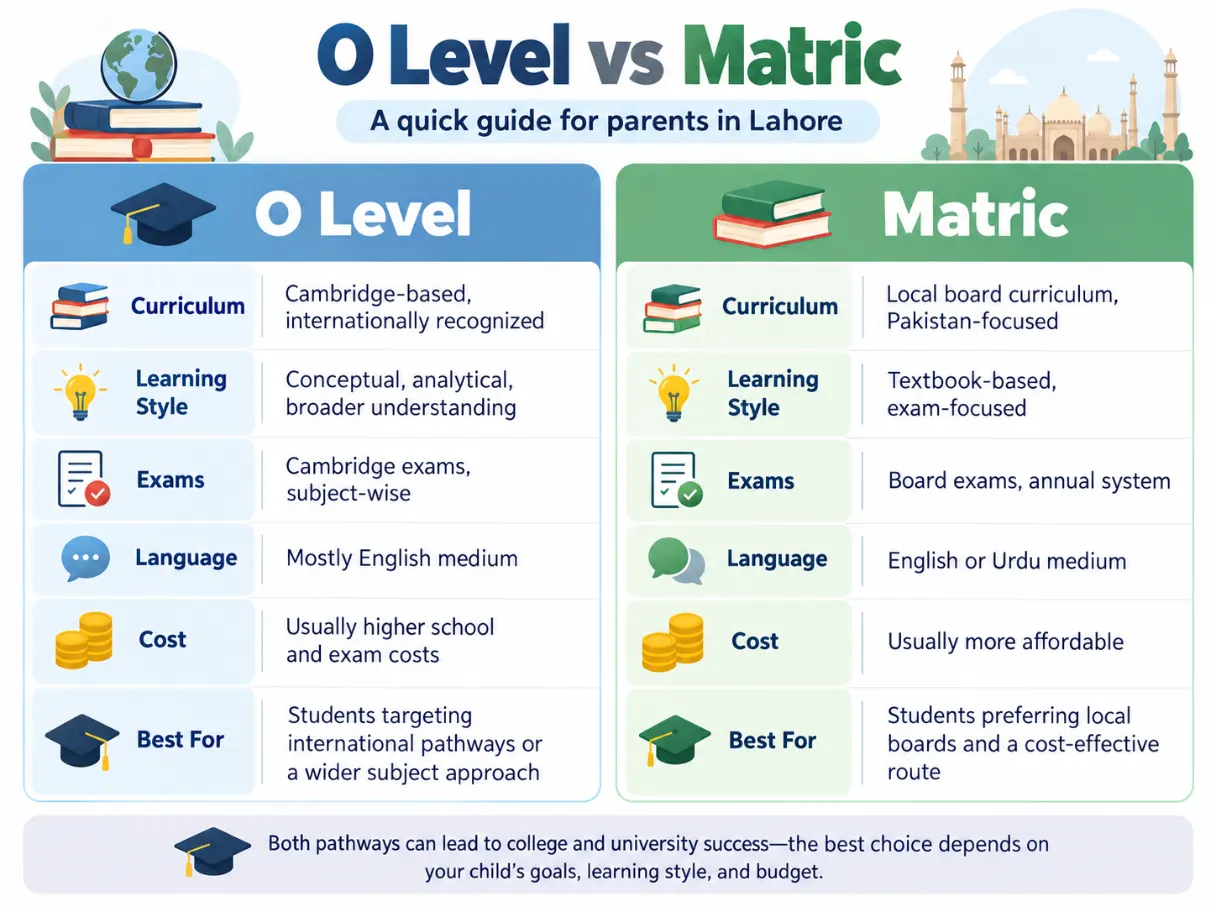
Quick answer: O Level is a Cambridge qualification graded A* to E, with exams marked in the UK and sat in May/June or October/November. Matric is the Pakistani Secondary School Certificate, set and marked by a board such as BISE Lahore. Both lead to A Level, FSc and university in Pakistan. O Level suits students aiming abroad or for Cambridge-style applied learning; Matric is cheaper and gives a direct marks-based record for local admissions such as MBBS merit.
Both paths are respected. The right one depends on your child's goals, your budget, and how they learn. This guide compares them on the points Lahore parents actually ask us about.
O Level vs Matric: Quick Comparison
| Cambridge O Level | Matric (SSC) | |
|---|---|---|
| Awarding body | Cambridge International, exams run by the British Council in Pakistan | Provincial or federal board, e.g. BISE Lahore or FBISE |
| Typical duration | 2–3 years (many Lahore schools run O1–O3) | 2 years: Class 9 (SSC-I) and Class 10 (SSC-II) |
| Subjects for local recognition | 8, five of them compulsory | Fixed scheme by group (Science or Arts) |
| Exam sessions | May/June and October/November | One annual exam per class, plus supplementary |
| Result format | Letter grades A* to E per subject | Marks and, from 2026, a 10-grade scale (A++ to U) |
| Pass mark | Grade E is the lowest IBCC accepts | 40% per subject from 2026 (previously 33%) |
| Needed for local admissions | IBCC equivalence certificate | Board certificate is used directly |
| Exam fees | Charged per subject, per session | Low board fees |
| Typical school fees in Lahore | Higher (private Cambridge schools) | Wide range, from government to premium private |
Syllabus, Subjects and Assessment Differences
Matric follows the national curriculum. Students choose a group in Class 9. The Science group takes Physics, Chemistry and either Biology or Computer Science alongside compulsory English, Urdu, Mathematics, Islamiyat and Pakistan Studies. Papers combine MCQs with short and long questions, and the board publishes past papers that closely predict the paper pattern.
O Level students pick subjects individually. For Pakistani candidates, IBCC requires eight O Level subjects, including Mathematics, English, Urdu, Islamiyat and Pakistan Studies, plus three electives. Popular electives in Lahore are Physics (5054), Chemistry (5070), Biology (5090), Computer Science (2210), Economics and Additional Mathematics (4037).
The bigger difference is the style of questions. Cambridge papers reward applying a concept to an unfamiliar situation and following the mark scheme's command words. Board papers lean more on knowing the textbook well. A student who memorises efficiently often does well in Matric, while a student who likes reasoning through problems tends to suit O Level. Neither is "easier"; they test different habits.
If your child is taking O Level Maths, read our guide on whether to add Additional Mathematics before finalising subjects.
Grading, IBCC Equivalence and University Admissions
To use O Level results for Pakistani admissions, students apply to the Inter Boards Coordination Commission (IBCC) for an equivalence certificate. IBCC converts each grade into marks using its official conversion table:
| O Level grade | IBCC equivalent marks (out of 100) |
|---|---|
| A* | Above 90, set per subject each year (from 2021) |
| A | 85 |
| B | 75 |
| C | 65 |
| D | 55 |
| E | 45 |
| F, G | Not accepted |
Worked example. A student with four A*s, three As and one B across the eight required subjects:
- Using 90 as the A* floor: (4 × 90) + (3 × 85) + 75 = 690 out of 800
- Equivalent percentage: about 86%, slightly higher once IBCC applies that year's subject-wise A* marks
This is the key point for parents: an excellent O Level result can convert to a lower percentage than a top Matric result, because an A grade is fixed at 85 and A* sits only slightly above 90. That matters most for public-sector MBBS and BDS admissions in Punjab, where merit combines Matric/FSc (or equivalent) marks with MDCAT. In September 2026, Punjab's Specialised Healthcare and Medical Education Department asked IBCC to review the O/A Level conversion for medical admissions, citing a possible disadvantage for top Cambridge students. No change has been implemented yet, so check the latest IBCC rules before deciding.
Matric grading is also changing. From the 2026 Class 9 exams, Pakistani boards use a revised IBCC grading scale with 40% as the pass mark; Class 10 follows from 2027. Under the new rules, BISE Lahore's 2026 Class 9 pass rate was 46.51%, which shows how much the higher pass mark matters for weaker students.
For admissions abroad, O Level is widely recognised as a GCSE-level qualification. Matric is accepted too, but universities overseas usually look at the next stage (A Level or FSc) and may ask for additional English testing.
School Fees and Additional Tuition Costs
Parents often mix up three separate costs. Keep them apart when comparing:
- School fees. Cambridge streams in Lahore's private schools usually cost more than Matric streams, often in the same school system. Compare named campuses, not network averages.
- Exam fees. Cambridge charges a fee per subject, per session, collected through the British Council or your school. One Pakistani school's October/November 2026 voucher lists about PKR 35,000 per O Level subject. Eight subjects add up quickly, and resits are charged again. Board exam fees for Matric are far lower.
- Private tuition. O Level tuition is usually charged per subject; Matric tuition usually covers the full group.
| Roots Home Tutors fee range (PKR per month) | Matric (BISE Lahore / FBISE) | O Level (Cambridge) |
|---|---|---|
| Published range | 18,000–20,000 | 20,000–22,000 per subject |
| Sessions per week | 3–5 | 2–4 |
| Example: support in Maths, Physics and Chemistry | One monthly package | Roughly 60,000–66,000 |
Exact fees depend on tutor experience, subjects and sessions. See our home tuition fees in Lahore for the full breakdown.
Which Path Fits Different Student Goals?
| If your child… | Lean toward | Why |
|---|---|---|
| Is targeting MBBS/BDS at a Punjab public college | Matric, then FSc Pre-Medical | Marks count directly in merit; equivalence formula is under review |
| Plans A Level or university abroad | O Level | Same exam family as A Level; familiar to foreign admissions offices |
| Prefers applying concepts to memorising | O Level | Cambridge papers reward reasoning and command-word technique |
| Does well with structured textbook revision | Matric | Board papers follow a predictable pattern |
| Is in a family where budget is a priority | Matric | Lower school, exam and tuition costs |
| Is already in O1/O2 and struggling | Stay, but get targeted help | Switching mid-way usually costs more time than fixing weak subjects |
Switching is possible in both directions, but it is easiest before Class 9 or O1 begins. A student moving from O Level to Matric must register with the board within its deadlines and cover the board syllabus, which differs topic by topic.
Frequently Asked Questions
Is O Level equal to Matric in Pakistan?
Yes, once IBCC issues an equivalence certificate. Students from Pakistan need eight O Level subjects with at least an E, including Maths, English, Urdu, Islamiyat and Pakistan Studies.
Can an O Level student do FSc instead of A Level?
Yes. With an IBCC equivalence certificate, O Level students can join FSc, ICS or ICom at colleges in Lahore.
Is O Level harder than Matric?
It is different rather than harder. O Level needs stronger English and problem-solving; Matric needs more consistent coverage of the board textbook.
Which is better for MBBS, O Level or Matric?
Matric followed by FSc Pre-Medical currently gives the most direct route into Punjab public medical merit. O and A Level students can still apply, but their marks pass through IBCC conversion.
How many subjects are needed in O Level?
Eight for students who sit from Pakistan, of which five are compulsory and three are electives.
Get the Right Tutor for Either Path
Whichever path you choose, results depend on teaching that matches the exact syllabus. Roots matches you with verified O Level home tutors in Lahore who teach to Cambridge mark schemes, and Matric and FSc tutors for BISE Lahore who work through board past papers.
Every match starts with a Free 2-Day Trial at home, and our trial-class checklist shows what to look for. WhatsApp 0329 8223185 with your child's class, subjects and area, and we will share matched tutor profiles, usually within 24 hours.
Sources
- IBCC — Conversion for Equivalence
- IBCC — FAQs (subject requirements)
- ProPakistani — BISE Lahore 9th class result 2026, grading and passing marks
- ProPakistani — BISE Lahore 9th class gazette 2026 (46.51% pass rate)
- TechJuice — Punjab seeks O/A Level equivalence review for medical admissions
- Eduvision — Punjab review, no change implemented yet
- British Council Pakistan — school exam registration and fees
- Sadiq Public School — O Level Oct/Nov 2026 fee voucher
Start Your Free 2-Day Trial
Request a Tutor
Takes 20 seconds. We call or WhatsApp you back.
Related reading
13 min read
Cambridge O Level Physics 5054 Study Guide for 2026–2027
Cambridge O Level Physics 5054 for 2026–2027: paper structure, key topics, worked numericals, Paper 3 vs Paper 4, past-paper tips and a six-week revision plan.
Read more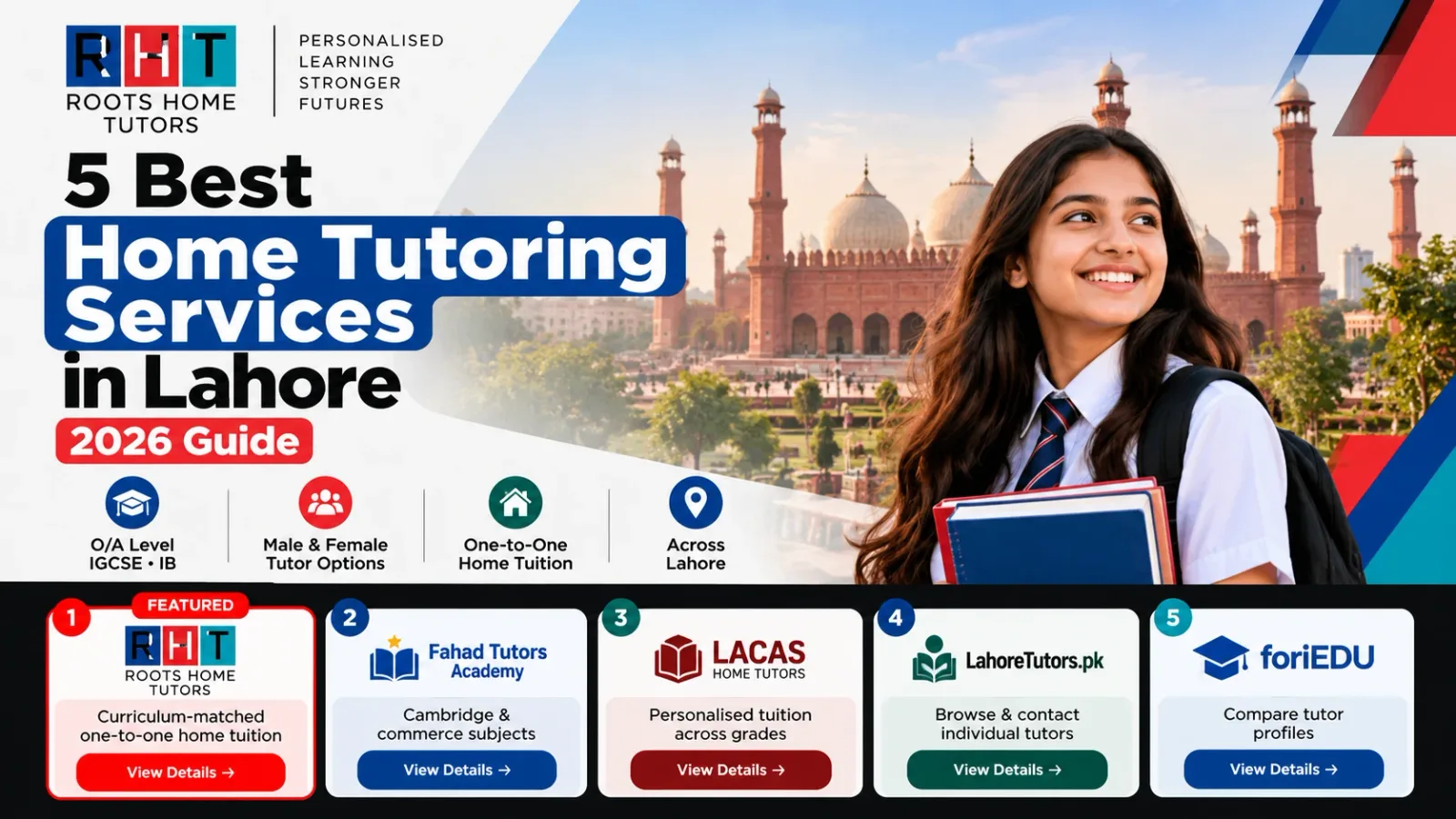
15 min read
5 Home Tutoring Services in Lahore Compared: Fees, Curricula & Tutor Options (2026)
Roots Home Tutors, Fahad Tutors Academy, LACAS Home Tutors, LahoreTutors.pk and foriEDU compared for Lahore parents: curricula, lesson formats, tutor selection, fees and what to check before hiring.
Read more
11 min read
Cambridge IGCSE vs Edexcel IGCSE: Which Is Better for Students in Pakistan?
Cambridge IGCSE vs Pearson Edexcel International GCSE in Pakistan: grading (A*–G vs 9–1), Maths and Science codes, IBCC equivalence, fees and how to choose a board-matched tutor in Lahore.
Read more