
Cambridge O Level Physics 5054 Study Guide for 2026–2027
13 min readBy Roots Home Tutors
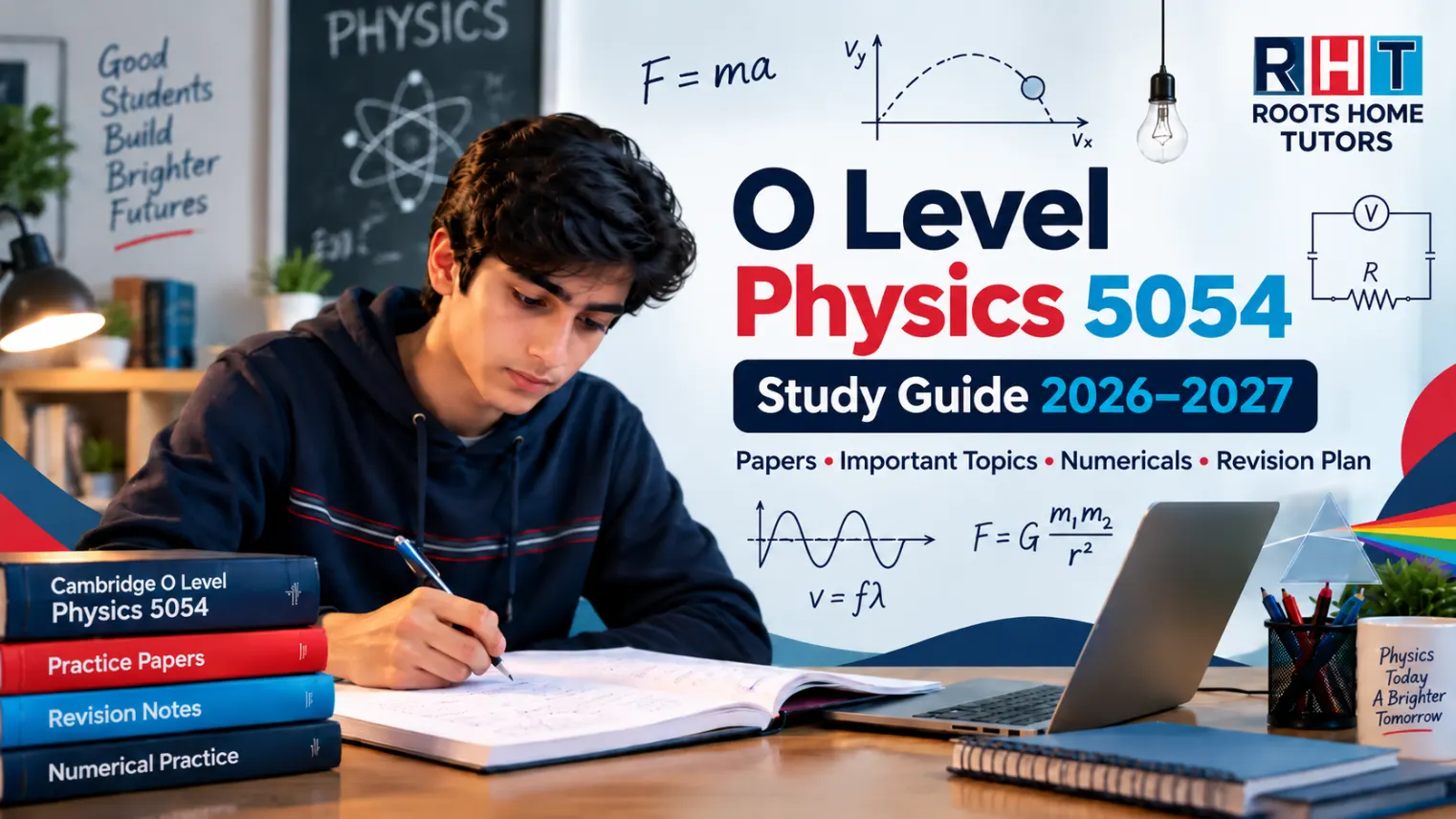
Cambridge O Level Physics (5054) can be challenging for students who understand scientific concepts in class but struggle to apply them in examination questions.
A student may remember Newton's laws yet find it difficult to calculate acceleration. Another may understand electricity but lose marks when rearranging equations, reading circuit diagrams or explaining an experiment.
For students preparing for the 2026 and 2027 Cambridge O Level Physics examinations, effective revision involves more than reading textbook chapters. It requires a clear understanding of the syllabus, regular numerical practice, knowledge of practical investigations and familiarity with examination questions.
This guide explains the Cambridge Physics 5054 examination structure, important syllabus topics, worked examples, common mistakes and a practical six-week revision plan.
It is particularly useful for O Level students in Lahore who want to identify weak areas before school mocks or final Cambridge examinations.
Cambridge O Level Physics 5054: Examination Structure for 2026–2027
Cambridge International's 2026–2028 Physics 5054 syllabus uses three examination components.
All candidates take Paper 1 and Paper 2, plus either Paper 3 or Paper 4 according to the examination entry arrangements.
| Paper | Assessment | Duration | Marks | Weighting |
|---|---|---|---|---|
| Paper 1 | Multiple Choice | 1 hour | 40 | 30% |
| Paper 2 | Theory | 1 hour 45 minutes | 80 | 50% |
| Paper 3 | Practical Test | 1 hour 30 minutes | 40 | 20% |
| Paper 4 | Alternative to Practical | 1 hour | 40 | 20% |
Students take either Paper 3 or Paper 4, not both.
Paper 1 consists of 40 multiple-choice questions. Paper 2 contains compulsory short-answer and structured questions.
Paper 3 assesses practical skills through laboratory experiments. Paper 4 assesses practical understanding through written questions without requiring students to perform experiments during the examination.
Important: Paper 2 carries the greatest individual weighting at 50%, but students should not ignore Paper 1 or their practical component.
Always use the syllabus appropriate to your examination year.
Official reference: Cambridge O Level Physics 5054 syllabus and assessment information.
Which Topics Should You Revise for O Level Physics 5054?
The Cambridge syllabus covers scientific principles, mathematical applications and practical skills.
Students should revise the full syllabus rather than relying on predicted examination questions.
The main subject areas include:
| Syllabus area | Important concepts | Skills to practise |
|---|---|---|
| Motion, forces and energy | Speed, acceleration, momentum, forces, energy, pressure | Equations, graphs, calculations |
| Thermal physics | Particle model, thermal properties, heat transfer | Explanations and quantitative reasoning |
| Waves | Wave behaviour, light and sound | Diagrams, calculations and wave properties |
| Electricity and magnetism | Circuits, resistance, power, magnetic effects | Circuit interpretation and numericals |
| Nuclear physics | Atomic structure, radioactivity | Scientific explanations and applications |
| Space physics | Solar System, stars and related concepts | Understanding and applying syllabus knowledge |
| Experimental skills | Variables, apparatus, measurements, graphs | Planning and interpreting experiments |
The 2026–2028 syllabus includes space physics and momentum, so students using older notes should verify that their materials cover the current content.
Why Do Students Lose Marks in O Level Physics?
Students often lose marks even when they have studied the relevant chapter.
The underlying problem is frequently one of four things: incomplete conceptual understanding, weak mathematical skills, unclear examination answers or difficulty interpreting experimental information.
1. Memorising formulas without understanding them
Consider the acceleration relationship:
Acceleration = Change in velocity ÷ Time
A student may memorise this equation but become confused when a question gives initial velocity, final velocity and time separately.
The student must first recognise that:
Change in velocity = Final velocity − Initial velocity
Understanding what the quantities represent makes it easier to select the correct method.
2. Missing units in numerical questions
Physics answers often require appropriate units.
A correct numerical value without its unit may be an incomplete answer when the unit is requested or assessed.
Students should be comfortable with units such as metres per second, newtons, joules, watts and amperes.
3. Confusing definitions with explanations
A definition question asks students to state the meaning of a scientific term.
An explanation question may require students to describe how or why a process occurs.
Writing a memorised definition does not always answer a question asking for scientific reasoning.
4. Weak graph interpretation
Motion graphs, experimental graphs and data tables require more than recalling information.
Students should practise identifying gradients, recognising trends, reading scales and explaining relationships between physical quantities.
5. Ignoring practical skills
Some students devote most of their preparation to theory and multiple-choice questions.
However, practical understanding contributes to the qualification and should be studied throughout the course.
Worked Example 1: Calculating Acceleration
A car increases its velocity from 5 m/s to 25 m/s in 4 seconds.
Calculate its acceleration.
Step 1: Identify the known quantities
Initial velocity = 5 m/s
Final velocity = 25 m/s
Time = 4 s
Step 2: Write the equation
Acceleration = (Final velocity − Initial velocity) ÷ Time
Step 3: Substitute the values
Acceleration = (25 − 5) ÷ 4
Acceleration = 20 ÷ 4
Answer = 5 m/s²
What does this example teach?
The important skill is not simply remembering the equation.
Students must identify which values represent initial and final velocity, calculate the change correctly and include the appropriate unit.
This approach becomes particularly useful when questions include unfamiliar contexts or motion graphs.
Worked Example 2: Calculating Electrical Resistance
A resistor has a potential difference of 12 V across it and a current of 3 A passing through it.
Calculate the resistance.
Step 1: Write the relationship
Potential difference = Current × Resistance
V = IR
Step 2: Rearrange
R = V ÷ I
Step 3: Substitute
R = 12 ÷ 3
Answer = 4 Ω
Common mistakes
Students may accidentally multiply instead of divide or confuse current with voltage.
Before solving the question, identify the physical quantity being calculated.
A useful habit is to write the relationship first, rearrange it and only then substitute numerical values.
Worked Example 3: Calculating Wave Speed
A wave has a frequency of 50 Hz and a wavelength of 2 m.
Calculate its speed.
Step 1: Recall the wave equation
Wave speed = Frequency × Wavelength
v = fλ
Step 2: Substitute
v = 50 × 2
Answer = 100 m/s
What should students remember?
Frequency is measured in hertz, wavelength in metres and wave speed in metres per second.
Students also need to interpret wave diagrams and understand what frequency, wavelength and amplitude mean.
These three examples are original learning exercises, not questions reproduced from a Cambridge examination paper.
How to Prepare for Paper 1: Multiple Choice
Paper 1 contains 40 compulsory multiple-choice questions.
Multiple-choice questions can be difficult because several options may appear reasonable.
Students need to identify exactly what the question is asking.
A useful four-step method
Read the question carefully. Identify the required quantity or scientific concept.
Check the units. Convert quantities where necessary.
Solve before choosing an option. For numerical questions, calculate the answer independently rather than relying on the options.
Eliminate incorrect answers. Look for wrong units, sign errors or scientific statements that contradict the relevant concept.
When reviewing a past paper, don't just record the total score.
For every incorrect answer, determine whether the mistake came from missing knowledge, incorrect calculation or misunderstanding the question.
How to Improve Your Paper 2 Theory Marks
Paper 2 contributes 50% of the overall assessment weighting.
It includes short-answer and structured questions, so students need to demonstrate both scientific knowledge and the ability to apply it.
Show your mathematical working
For numerical questions, a clear sequence usually includes:
- The correct relationship.
- Rearrangement where required.
- Substitution of values.
- Calculation.
- Appropriate units.
Use precise scientific language
Words such as force, pressure, power, energy and momentum describe different physical quantities.
Using them interchangeably can make explanations inaccurate.
Match the command word
Pay attention to words such as state, describe, explain, calculate and determine.
For example, explaining why an object accelerates requires reasoning about forces, not just stating the equation for acceleration.
Practise unfamiliar applications
Students should move beyond chapter exercises and attempt mixed examination questions.
The aim is to identify the relevant Physics when the question does not explicitly name the topic.
For students who repeatedly struggle with equations or scientific explanations, one-to-one Physics home tuition in Lahore can provide focused support with these skills.

Paper 3 vs Paper 4: Practical and Alternative to Practical
Students should confirm which practical assessment they are entered for.
Paper 3 requires candidates to perform experimental work during the examination.
Paper 4 assesses practical skills through written questions without requiring candidates to conduct experiments.
Despite the different examination formats, both assess practical scientific understanding.
Important practical skills to revise
Identifying variables: Understand independent, dependent and controlled variables.
Using apparatus: Know the function of common instruments and how measurements are taken.
Recording readings: Use suitable tables, units and appropriate precision.
Drawing graphs: Choose suitable scales, label axes and plot points accurately.
Interpreting results: Explain trends and identify relationships.
Evaluating methods: Recognise experimental limitations and suggest meaningful improvements.
Planning investigations: Describe how to investigate a relationship while controlling relevant variables.
Example: Investigating resistance
Suppose a student investigates how the resistance of a wire changes with its length.
The length of the wire is the independent variable.
The measured resistance is the dependent variable.
Other relevant conditions, including the wire's material and cross-sectional area, should be controlled.
The student should also consider temperature effects and safe experimental arrangements.
This is an example of the reasoning required for practical investigations.
A student cannot prepare effectively for practical questions by memorising only theoretical definitions.
Six-Week O Level Physics 5054 Revision Plan
A structured timetable can help students balance Physics with other O Level subjects.
This plan assumes that most syllabus content has already been taught.
| Week | Main revision focus | Recommended activity |
|---|---|---|
| Week 1 | Motion, forces, energy and momentum | Concept review, numericals, motion graphs |
| Week 2 | Thermal physics and waves | Explanations, diagrams and calculation practice |
| Week 3 | Electricity and magnetism | Circuit questions, equations and mixed practice |
| Week 4 | Nuclear and space physics | Syllabus revision, structured questions, MCQs |
| Week 5 | Practical skills and weak topics | Graphs, experimental planning and paper-specific practice |
| Week 6 | Full examination preparation | Timed papers, mark-scheme review and error correction |
Suggested weekly routine
Students may begin with four focused Physics revision sessions each week.
Session 1: Learn or revisit difficult concepts.
Session 2: Practise mathematical calculations and diagrams.
Session 3: Complete topical Cambridge questions.
Session 4: Review incorrect answers and practise practical skills.
The appropriate amount of study time depends on the student's school workload, current understanding and examination date.
How to Use O Level Physics Past Papers Properly
Completing large numbers of past papers does not automatically improve examination performance.
The greatest benefit comes from understanding mistakes.
Start with topical questions
When learning electricity, focus on relevant circuit and calculation questions.
When revising waves, practise the associated definitions, relationships and diagrams.
Move to mixed questions
Once students understand individual chapters, begin mixed-topic practice.
This develops the ability to recognise which scientific principles apply.
Attempt current-format papers
Use papers appropriate to the 2026–2028 syllabus and supplement these with older questions where the content remains relevant.
Be careful when using past papers from previous syllabus versions because topic coverage and assessment structure may differ.
Maintain an error log
| Question topic | Mistake | Corrective action |
|---|---|---|
| Acceleration | Forgot to subtract initial velocity | Practise change-in-velocity calculations |
| Electricity | Mixed up voltage and current | Revisit V = IR |
| Waves | Incorrect wavelength unit | Practise unit conversions |
| Practical skills | Did not control a variable | Review experiment planning |
Reattempt difficult questions after a few days without looking at the mark scheme.
If students can now solve them independently, that is useful evidence of progress.
O Level Physics Revision for Students in Lahore
Students studying Cambridge O Level Physics in Lahore may attend schools in DHA, Gulberg, Johar Town, Model Town, Bahria Town and other areas.
The school name alone does not identify the student's current academic weaknesses.
For example, one O Level student may struggle with electrical circuits, while another understands the theory but needs more examination practice.
Parents should review their child's recent school tests or mock results before arranging additional lessons.
A productive conversation with the student might include:
- Which topics feel most difficult?
- Are mistakes mainly conceptual or mathematical?
- Is the student completing the paper within the time allowed?
- Does the student understand practical questions?
- Can they correct past mistakes independently?
Students also studying Chemistry and Mathematics may benefit from identifying shared weaknesses in algebra, ratios, graphs and scientific calculations.
For broader Cambridge subject support, explore O Level home tutors in Lahore.
When Should Parents Consider an O Level Physics Tutor?
Not every O Level student needs private tuition.
Some students can revise successfully through their school lessons, textbooks, teacher feedback and independent practice.
Additional support may be useful when a student repeatedly encounters the same difficulties.
For example, a student might understand electrical current and potential difference separately but struggle to solve circuit problems involving both.
Another might know the facts behind an experiment but fail to explain which variables must be controlled.
A suitable Physics tutor should begin by identifying these specific learning gaps.
At Roots Home Tutors, parents can request male or female Physics tutors for Cambridge O Level 5054.
Lessons can focus on conceptual explanations, numerical problem-solving, examination technique and practical-skills preparation.
Tutor matching considers the student's syllabus, area in Lahore and preferred lesson schedule.
Explore Physics Home Tutors in Lahore
Frequently Asked Questions About O Level Physics 5054
How many papers are there in O Level Physics 5054?
Candidates take three components: Paper 1 Multiple Choice, Paper 2 Theory and either Paper 3 Practical Test or Paper 4 Alternative to Practical.
Which Physics 5054 paper carries the most marks?
Paper 2 Theory contributes 50% of the overall weighting. Paper 1 contributes 30%, while the selected practical component contributes 20%.
Is O Level Physics 5054 difficult?
Physics can be challenging because students must understand concepts and apply Mathematics to scientific problems. Difficulty varies by topic and student, but consistent conceptual and numerical practice can help.
Is Paper 4 easier than Paper 3?
Neither is automatically easier. Paper 3 requires laboratory experiments during the examination, while Paper 4 tests practical understanding through written questions. Both assess experimental skills.
Can I use 2023–2025 Physics past papers for 2027 examinations?
Older papers can help with relevant topic practice. However, students should prepare using the 2026–2028 syllabus and check whether older questions match its content and assessment requirements.
Which Physics topics require the most calculation practice?
Motion, forces, energy, electricity and waves include important mathematical relationships. Students should also practise calculations and data interpretation wherever required by the full syllabus.
How long does it take to prepare for O Level Physics?
There is no single timetable suitable for everyone. Students who understand most topics may benefit from several weeks of structured revision, while those with major learning gaps need more time.
How much does an O Level Physics home tutor cost in Lahore?
Roots Home Tutors advertises O Level tuition at approximately PKR 20,000–22,000 per subject per month, depending on the tutor and agreed teaching arrangement.
Can I find a female O Level Physics tutor in Lahore?
Roots accepts requests for female Physics tutors. Availability depends on the student's location, subject requirements and preferred schedule.
Does Roots Home Tutors offer a trial class?
Roots advertises a free two-day tutoring trial so parents and students can evaluate the teaching arrangement before continuing with regular lessons.
Final Thoughts: Preparing for Physics 5054 With Confidence
O Level Physics is not a subject students can prepare for successfully by memorising equations alone.
Students need to understand scientific concepts, identify relevant relationships, perform calculations accurately and explain their reasoning.
For Cambridge O Level Physics 5054 examinations in 2026 and 2027, begin with the current syllabus, identify weak topics and practise all three required assessment components.
Use past papers carefully, review mistakes and develop the habit of solving unfamiliar problems independently.
The goal is to improve both subject understanding and examination technique.
Need an O Level Physics Home Tutor in Lahore?
Roots Home Tutors connects families with male and female home tutors for Cambridge O Level Physics 5054 across Lahore.
Tutoring can be tailored to the student's difficult topics, school assessments, examination timetable and academic goals.
Our service includes:
- One-to-one home tuition.
- Subject and syllabus-based tutor matching.
- Numerical and theory examination preparation.
- Practical-skills revision.
- A free two-day trial.
- Tutor replacement support subject to service arrangements.
Find an O Level Physics Home Tutor
Explore All O Level Home Tutors
Find Home Tutors Across Lahore
WhatsApp: 0329 8223185
Roots Home Tutors is an independent tuition provider and is not affiliated with Cambridge International Education.
Official syllabus: Cambridge O Level Physics 5054 — 2026–2028
Start Your Free 2-Day Trial
Request a Tutor
Takes 20 seconds. We call or WhatsApp you back.
Related reading

15 min read
5 Home Tutoring Services in Lahore Compared: Fees, Curricula & Tutor Options (2026)
Roots Home Tutors, Fahad Tutors Academy, LACAS Home Tutors, LahoreTutors.pk and foriEDU compared for Lahore parents: curricula, lesson formats, tutor selection, fees and what to check before hiring.
Read more
11 min read
Cambridge IGCSE vs Edexcel IGCSE: Which Is Better for Students in Pakistan?
Cambridge IGCSE vs Pearson Edexcel International GCSE in Pakistan: grading (A*–G vs 9–1), Maths and Science codes, IBCC equivalence, fees and how to choose a board-matched tutor in Lahore.
Read more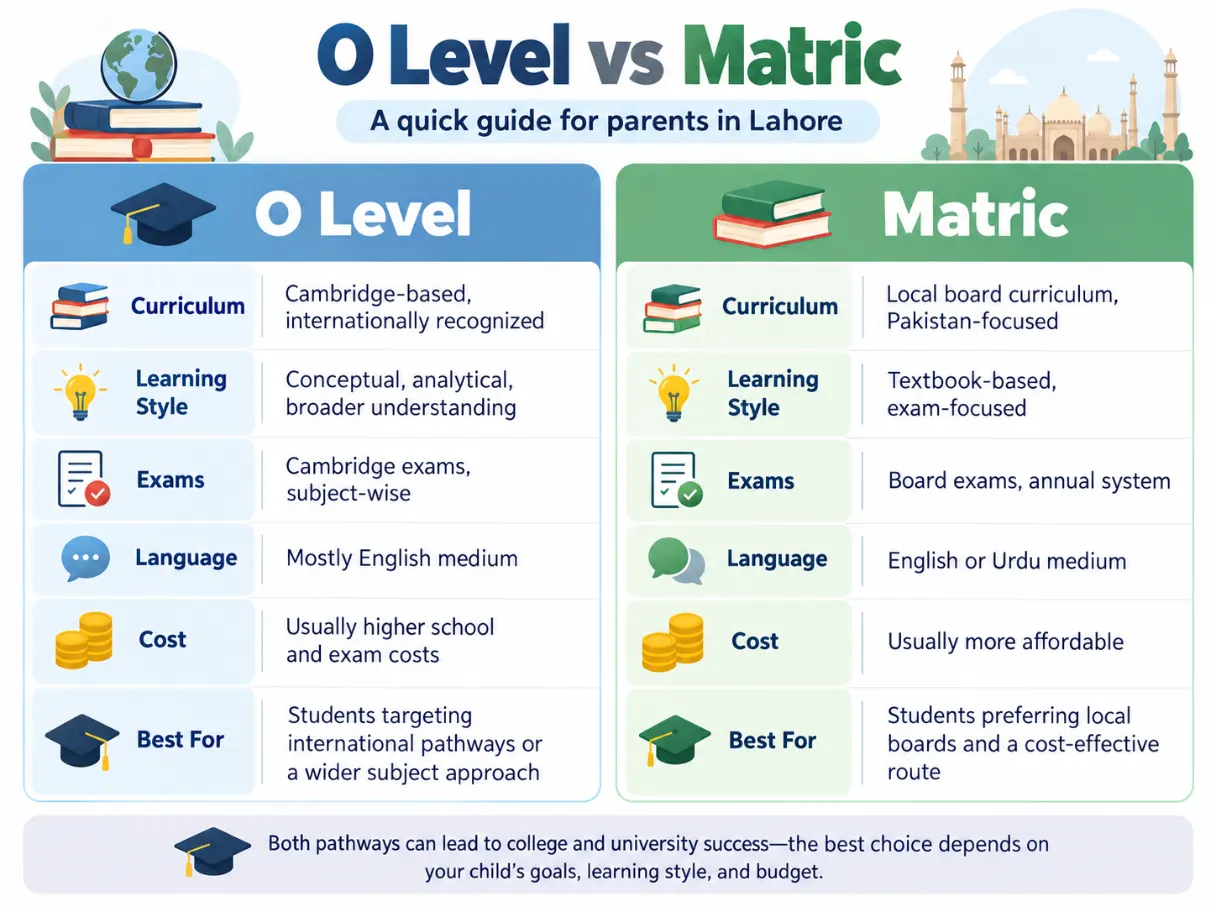
6 min read
O Level vs Matric in Pakistan: Subjects, Fees & Future Options
O Level vs Matric compared for Lahore parents: subjects, exams, IBCC equivalence, grade-to-marks conversion, school and tuition costs, and which path suits whom.
Read more