
Exam Preparation Tutor vs Regular Tutor: What Does Your Child Need?
4 min readBy Roots Home Tutors
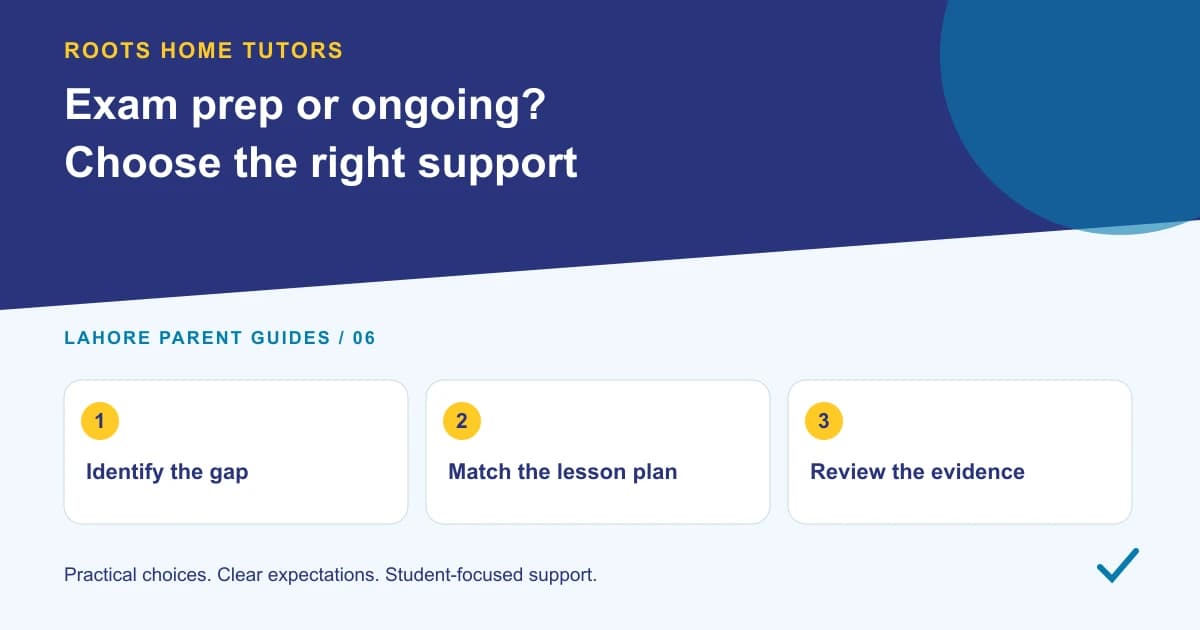
An exam preparation tutor focuses on a defined assessment: relevant content, question technique, timing and marking requirements. Regular academic tuition supports understanding and school learning over time. A student may need both, and the same suitably experienced tutor may provide both.
Choose the lesson plan by the student’s actual needs, not the label on a tutor’s profile. For Lahore families, start with the subject, board, current difficulties and examination date.
How the two approaches differ
| Factor | Exam preparation | Regular academic tuition |
|---|---|---|
| Main purpose | Prepare for a specified assessment | Build understanding and keep learning on track |
| Starting point | Paper requirements and diagnostic work | Current topics and foundational gaps |
| Lesson activities | Targeted revision, question analysis and timed practice | Explanation, guided practice and independent application |
| Progress evidence | Comparable practice responses and recurring error patterns | Independent work, retention and use of new skills |
| Planning horizon | Works backwards from the assessment date | Follows learning needs and school milestones |
These are priorities, not rigid boundaries. Good exam preparation still teaches missing concepts. Good regular tuition can include assessment practice when appropriate.
When regular tuition is the better starting point
Choose sustained academic support when the student frequently misses the meaning of current lessons, relies on help for basic tasks or has gaps that affect several topics. More past papers alone may not solve those problems.
For example, an O Level Mathematics student who cannot rearrange equations may struggle across several question types. Teaching the underlying skill should come before repeated timed attempts at questions they cannot yet understand.
Regular support is also useful when a student needs a workable study routine. Ask how the tutor will connect lessons with schoolwork without simply completing homework for the child.
When exam-focused support makes sense
A focused plan can help when the student understands much of the content but struggles with command words, question selection, timing or applying knowledge under assessment conditions.
Share the examination date, syllabus, paper details and recent practice work. Ask the tutor to separate content gaps from technique problems. That distinction determines whether the next lesson should teach a concept, review an answer or practise timing.
For Matric and FSc, specify the board and current course requirements. For O Level, IGCSE and A Level, confirm the subject and relevant syllabus year. For IB, identify the programme, subject and level. Do not assume one examination approach transfers unchanged across them.
Build a combined plan when needs overlap
Start with a diagnostic task. List unfinished content, recurring errors and assessment demands. Then agree which items deserve attention first and how independent practice will fit between lessons.
Illustrative example: a student understands a chemistry topic but loses marks through incomplete explanations. A lesson might revisit the concept briefly, analyse a response and finish with a new independent question. Another student may need most of that lesson devoted to foundational teaching.
There is no universal number of weeks that makes exam tuition effective. Available time, attendance, starting knowledge and the scope of the assessment all matter. A responsible tutor should explain the priorities and limits of the plan.
Ask these questions before booking
- Have you taught this subject, level and examination syllabus?
- How will you distinguish knowledge gaps from technique issues?
- What would the first few lessons cover, and why?
- Which materials will you use?
- How will you review independent answers?
- What practice is realistic between sessions?
- How will the plan change if progress is slower than expected?
Use our verification and interview guide to check the candidate, then assess the proposed approach during a trial class.
Make the Lahore schedule workable
Confirm your area, block, preferred days and school or college timetable. More sessions are not automatically better if travel, other commitments and independent study leave the student exhausted.
Agree lesson duration, fees, cancellations and communication before starting. Describe the support you need precisely: “help with current chapters and foundational algebra” is different from “timed practice for an upcoming mathematics paper.”
Before increasing lesson frequency, ask what the extra time will achieve. An additional session should have a defined purpose, such as addressing a missing topic or reviewing independent practice. Leave time for the student to use feedback between lessons instead of filling every available evening with instruction.
Review learning, not promises
Avoid choosing a tutor because they guarantee a particular grade. Ask for evidence of relevant teaching experience and a clear, adaptable plan. Use our progress-tracking framework to see whether the student can apply learning independently.
If the plan remains unsuitable, discuss adjustments or use the replacement decision guide. Explore Roots home tuition in Lahore or request a tutor matched to your subject and assessment needs.
Get Expert Tutor Now
Get a verified male or female tutor matched to your syllabus, with a free 2-day trial before you pay anything.
- We reply during office hoursMon – Sun, 9:30 AM to 11:30 PM
- Free 2-day trialNothing to pay until you’ve seen a lesson
- Office29-J3, Block J3 Abdul Haque Rd, opp. Expo Center Road, Block J3 Phase 2 Johar Town, Lahore, 54000
Request a Tutor
We reply on WhatsApp or by phone.
Related reading
3 min read
Home Tutor Trial-Class Checklist for Lahore Parents
Assess a Lahore home tutor’s teaching, subject knowledge and student fit. Use this practical trial-class checklist before agreeing to regular tuition.
Read more
4 min read
How to Verify and Interview a Home Tutor in Lahore
Check a Lahore home tutor’s identity, qualifications and curriculum experience. Use 15 interview questions before arranging a trial lesson.
Read more
4 min read
Male or Female Home Tutor? A Guide for Lahore Parents
Choose a male or female home tutor in Lahore based on student comfort, curriculum knowledge, teaching quality and a workable lesson schedule.
Read more